What Is “The Nest”? – A Framework for Children to Grow and Thrive
Imagine a bird building a nest. It weaves together twigs, leaves and feathers to build something strong enough to keep the chick safe.
This same idea sits behind the framework’s name. ARACY, an Australian organisation that supports child wellbeing research, calls their wellbeing framework The Nest. The name came from a young person during research and the design of the framework – on reflection they said all the parts of wellbeing were like a nest: if every area is supported, we’re able to be happy and healthy and fly from the nest.
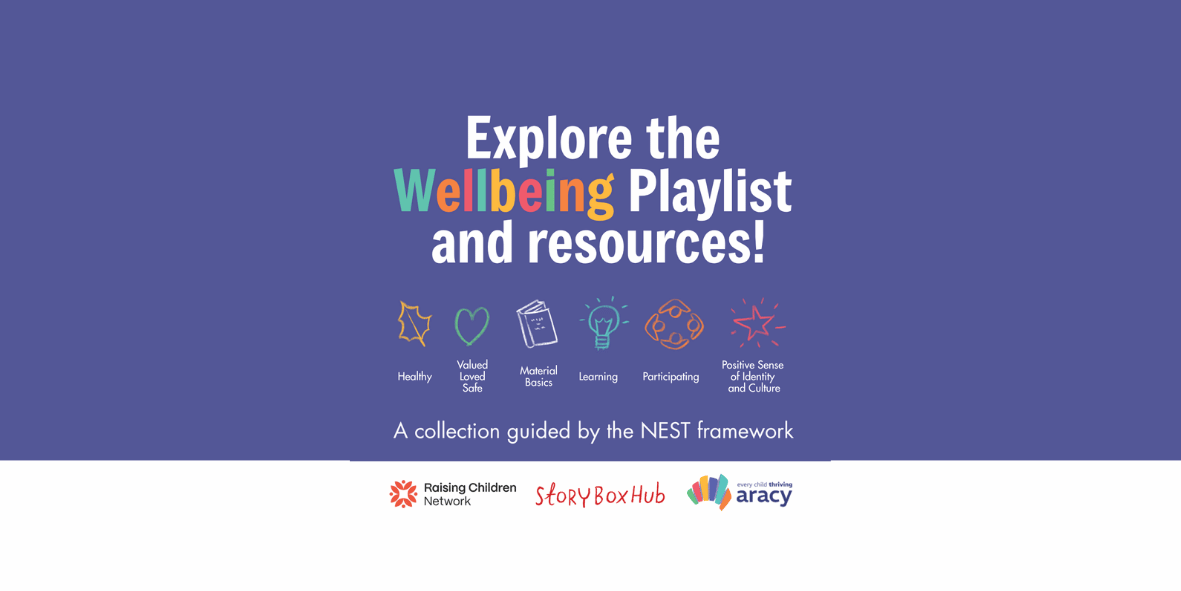
The Nest Wellbeing Framework for Children and Young People explains that for a child to thrive, there are six things that need to come together around them.
The Six Twigs of the The Nest
I am Valued, Loved and Safe.
Feeling cared about by family, friends and other adults. Feeling safe at home, in the community and online.
I am Healthy.
Having your body and mind looked after – enough sleep, good food and help when you’re sick or worried.
I have Material Basics.
Having the everyday things you need: a safe place to live, clothes, food, water and school supplies.
I am Learning.
Being able to learn and discover things – at school, at home and out in the world – in a way that fits you.
I am Participating.
Having a say. Being listened to and being involved in decisions that affect you, whether at home, school or with friends.
I have a Positive Sense of Identity and Culture.
Feeling proud of who you are, where you come from, knowing your culture and identity are respected and being able to freely express those aspects of yourself.
Why It’s a Nest, Not a Checklist
A nest isn’t six separate piles of twigs sitting next to each other. It’s one woven structure, and every twig depends on the others for the nest to hold its shape.
Take away just one twig – imagine a child stops feeling safe – and the whole nest can start to sag, even with every other twig still in place. A child who’s healthy but never gets listened to isn’t fully thriving. A child with all their material basics provided for but no sense of being loved isn’t either. Each domain connects to the others, so if one weakens, it affects the whole. That’s what “interdependent” means.
The Nest Doesn’t Float Alone
A real nest isn’t just hanging in mid-air, either. It sits on a branch. The branch is part of a tree. The tree grows in a forest. Each of those layers supports one another and The Nest framework works the same way, across what are known as ecological levels:
• The child at the centre.
• Family, the closest layer – the people who nurture, comfort and raise the child day to day.
• Community – friends, school, neighbours, local services and the environment a child grows up in.
• Society and Systems – the wider community, governments and broader culture that shape the conditions everyone lives in, like laws, policies, social trends, funding for schools and health care and how a country values its children.
Support has to flow through all four levels for a child to truly thrive.
The Big Idea
Wellbeing isn’t one thing you either have or don’t have. It’s a result of a nest of things, woven together, held up by the people and places around a child at every level – family, community and society.
When all six areas are present, strong and well connected, a child has what they need to grow, feel secure, be resilient and eventually fly the nest.
Sharing stories is a powerful way to prompt reflection and discussion with children about almost ANY topic! And the wonderful thing is that reading, talking and sharing stories positively contributes to almost all of The Nest domains. While you’re talking about wellbeing, you’ll be contributing to it too!
A note for educators and professionals
It’s important to have a common understanding and language to talk about ‘wellbeing’. One of the most common interpretations is that wellbeing refers to an individual’s emotional or psychological state. While this is a valid and important aspect of wellbeing, as we’ve explored above, it is not the only factor – it is crucial that we acknowledge a more holistic view of the inputs to avoid blind spots or missed opportunities to support children and families in the most effective ways.
Written by Kirrin Sampson B.A. M.Teach MAICD
Previously with ARACY, and currently the Strategic Partnerships Executive with Early Childhood Australia, Kirrin works towards supporting national programs, initiatives, and systems change that underpin the best developmental and life outcomes for Australian children.
She is a non-executive director for The Children’s Book Council Australia, Raising Literacy Australia and The National Centre for Australian Children’s Literature.
Kirrin previously worked for the Australian Library and Information Association (ALIA), where she supported the development of many library-based literary and literacy programs and advocacy initiatives, including ALIA’s National Simultaneous Storytime, Speechie Library Talks with Speech Pathology Australia, and the National Early Language and Literacy Coalition.
She has served as a judge for The Prime Minister’s Literary Awards, the ABIAs, the CBCA Book of the Year Awards, and advised on a number of literary initiatives, including Reading Australia.
SHARE THIS
With six connected areas, The Nest ensures young Australians have everything they need for the best start in life, helping them reach their highest potential.
Using The Nest, has helped ARACY to be at the forefront of disease prevention and the promotion of holistic health for young Australians.
Here you’ll see some examples of how The Nest has been used in organisations outside of ARACY across Australia.