Training and Events

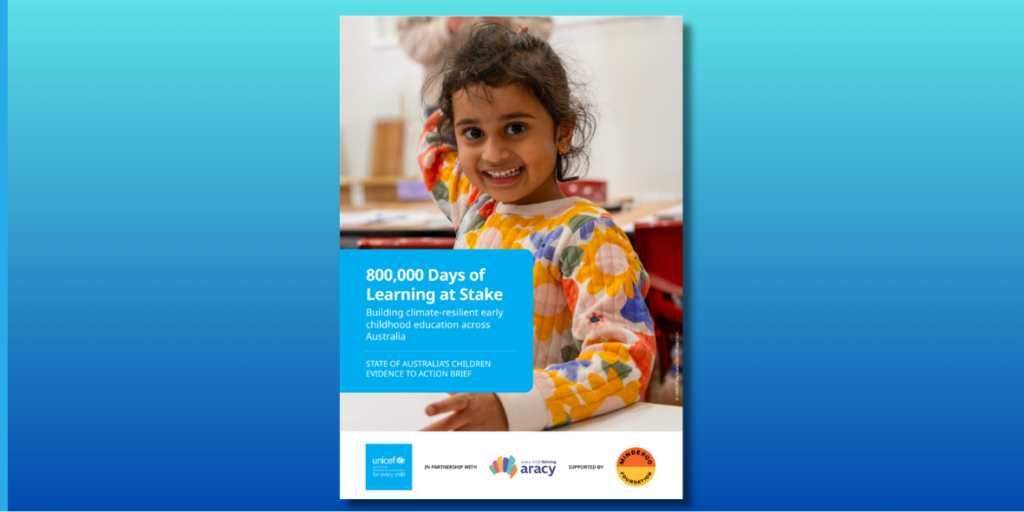
800,000 Days of Learning at Stake: Building climate-resilient early childhood education across Australia

Wednesday, 22 July 2026: 1 pm –2 pm AEST

Presented by UNICEF Australia and ARACY, and supported by Minderoo Foundation, this State of Australia’s Children webinar explores how climate-resilient early learning environments can support children’s health, development and wellbeing now and into the future.

800,000 Days of Learning at Stake is the State of Australia’s Children Evidence to Action Brief on climate change and early childhood infrastructure. It examines how climate change is affecting early childhood education and care, including the physical environments children learn in, the social infrastructure that supports them, and the systems needed to keep children safe, connected and learning through climate events. 

Rather than focusing only on the risks, this webinar will highlight what can be done. It will bring together evidence, child development expertise, practical examples and policy recommendations to show how early learning services can be designed, supported and strengthened as vital community infrastructure.

Speakers will explore why the early years matter, how children’s environments shape their health and learning, and what governments, educators, designers, communities and funders can do to create early learning settings that are safe, stable, inclusive and resilient.

Why Attend / What You’ll Learn

  • How climate change is affecting early childhood education and care
  • Why climate-resilient early learning is essential for children’s health, development and wellbeing
  • How the physical and social environments around children shape their ability to thrive
  • Practical examples of what climate-ready early learning can look like
  • How educators, designers, governments and communities can work together to support children according to their needs
  • Key policy and investment opportunities to strengthen early learning infrastructure across Australia

Meet your speakers

  • Diana Harris — Lead for Strategy and Operations, ARACY (Webinar MC)
  • Megan O’Connell — Children’s Index Project Manager, ARACY
  • Alice Hall — Chief Advocate for Children, UNICEF Australia
  • Nic Seton — CEO, Parents for Climate
  • Helen Travers — Manager, Schools Up North (SUN) Program, YETI (Youth Empowered Towards Independence)
  • Danielle Williams — Education Consultant, Schools Up North (SUN) Program, YETI (Youth Empowered Towards Independence)


Once you register, you’ll receive a confirmation email with your link to join. We’ll also send a reminder the day before and on the day so you don’t miss it!


Click on the images below for the full speaker bios.

Register now

Privacy collection statement
ARACY respects your privacy and is committed to protecting your personal information. When you interact with us, we may collect certain details to provide our services, such as your name and contact information. This information will only be used for purposes directly related to our business activities and will not be shared with third parties without your consent, except where required by law. By engaging with us, you consent to the collection and use of your information. Please refer to our privacy policy for more details on how we handle your information.

Diana Harris

Lead for Strategy and Operations

ARACY’s Lead for Strategy and Operations. Her responsibilities include oversight of internal operations, delivery of ARACY’s Strategic Plan, governance and reporting, and managing delivery and risk.

Diana’s career has encompassed local and federal government, community engagement, policy development, program delivery and management consultancy. She is a well-regarded program leader and performance professional with international experience in children’s and community policy, including the implementation of Getting it Right For Every Child in the Scottish Borders and Neighbourhood Partnerships for City of Edinburgh Council.

Diana is raising two amazing neurodivergent kids, loves reading fantasy and YA, and is the sole cat person at ARACY.

Nic Seton

CEO - Parents for Climate

Nic Seton is the CEO of Parents for Climate, Australia’s leading climate advocacy organisation for parents and carers. Since stepping into the role in 2021, Nic has led the organisation through a period of rapid growth and major impact — expanding its national footprint, securing significant policy wins, and mobilising thousands of families to take action for a safe climate future.

With over 16 years of leadership and campaign experience across NGOs in Australia and the UK, Nic brings deep expertise in public engagement, strategic advocacy, and movement building. A former stay-at-home dad, he’s passionate about making climate action accessible, powerful, and parent-powered.

Nic lives in Sydney with his two incredible kids and an inspiring partner. They have a lot of fun exploring nature and playing together.

Associate Professor Sally Staton

Associate Professor in Child Development, Australian Research Council (ARC) Industry Fellow, and Leader of the Brain Health and Early Development Research Group, The University of Queensland

Associate Professor Sally Staton is an applied developmental scientist and ARC Industry Fellow at The University of Queensland’s Child Health Research Centre, where she leads the Brain Health and Early Development Research Group. Her research examines how early experiences and the physical and social environments in which children live, learn, and grow shape development, learning, brain health, and wellbeing. With a particular focus on early childhood education and care (ECEC), she investigates how policies, practices, and environments can create the conditions for children to thrive. Sally leads the ARC-funded Building Futures project, which is generating evidence to inform ECEC policy, regulation, licensing, and practice. Through partnerships with educators, policymakers, governments, and communities, she works to ensure research informs the systems that support children, young people, and their families. Sally has authored more than 200 publications and has been previously recognised as one of Australia’s Young Tall Poppy Scientists for her contribution to research impact and science communication.

Megan O'Connell

Children's Index Project Manager - ARACY

Megan is one of Australia’s leading policy experts, with experience across the entire education spectrum, from early childhood, to schooling and vocational and higher education. She has a strong focus on ensuring all children and young people are supported to develop the skills and capabilities they need to navigate a changing future. Her work frequently underpins policy that improves outcomes for young Australians.

Megan is an Honorary Fellow of the Melbourne Graduate School of Education and an education policy consultant. As director of Megan O’Connell Consulting, Megan supports organisations to use data, evidence and stories to understand, communicate and address challenging issues.

Alice Hall

Chief Advocate for Children - UNICEF Australia

As Chief Advocate for Children at UNICEF Australia, I work to elevate the rights and voices of children – influencing policy, shaping public discourse, and building the partnerships needed to deliver lasting change.
 
In my role I bring together strategy, advocacy and engagement to drive impact in priority areas including climate change, children’s safety and wellbeing, and ensuring children are protected and prioritised in times of crisis. Working with a passionate and dedicated team, our focus is on translating evidence into action, connecting government, business, civil society and communities around shared solutions for children.
 
Since joining UNICEF Australia in 2016, I’ve held leadership roles across international programs, disability inclusion and global management, including as Chief of Staff, where I led organisation-wide strategic and cross-functional initiatives. Throughout this, I’ve worked with colleagues to strengthen influence systems, scale impact, and deliver for children in complex and rapidly changing contexts.

Helen Travers

Manager - Schools Up North (SUN) Program at YETI (Youth Empowered Towards Independence)

Helen Travers has spent 30 years working in Aboriginal and Torres Strait Islander population health initiatives in Far North Queensland. With a background in nursing and midwifery, she has worked across health promotion, community capacity building, social enterprise and media for development.

For the past nine years, Helen has managed the Schools Up North (SUN) Program at YETI (Youth Empowered Towards Independence) in Cairns. SUN works with schools, teachers and community leaders across Cape York and the Torres Strait Islands to strengthen relationships, local ownership, engagement and everyday practice, to improve wellbeing outcomes for Indigenous children and young people.


SUN has recently published the Kowanyama Youth Profile 2025-26. Kowanyama Council aims to be a leader on Cape York by implementing a purpose-designed, evidence and values-based youth strategy that includes young people in decision-making. The Profile represents a step in that process and will inform the development of the Kowanyama Youth Strategy 2026-30.

Danielle Williams

Education consultant - Schools Up North (SUN) Program at YETI (Youth Empowered Towards Independence).

Danielle Williams is a teacher and education consultant who has worked with young people and families across Cape York and the Torres Strait for over fifteen years, particularly those from remote First Nations communities. She currently works as a consultant with the Schools Up North (SUN) Program at YETI (Youth Empowered Towards Independence).

She has significant experience in the support and transition of remote First Nations students to boarding high schools, developing career and support pathways for young people post-school, and capacity development of teachers new to remote teaching. Currently, Danielle’s areas of focus include community engagement and capacity development, and connecting and enhancing relationships between education systems and other organisations that work with young people in remote communities.