What We Do
The Nest Wellbeing Framework

What is The Nest Wellbeing Framework?
The Nest Wellbeing Framework (The Nest) is Australia’s first evidence-based framework for child and youth wellbeing. Developed by ARACY (the Australian Research Alliance for Children and Youth) in 2013, following consultation with over 4,000 children, families and experts, it defines six interconnected domains that children and young people need to thrive:
- Healthy
- Valued, Loved and Safe
- Material Basics
- Learning
- Participating
- Positive Sense of Identity and Culture
The Nest recognises every facet of a child’s life as integral to preventing harm, enabling early intervention, and creating the conditions for every young Australian to reach their full potential. Licensed under Creative Commons, it is free to use in policy and practice.
Individuals, agencies, government departments, policymakers, researchers, and community organisations across Australia bring The Nest to life when they use it to frame their work — driving population-level change in the health and development of children and young people.
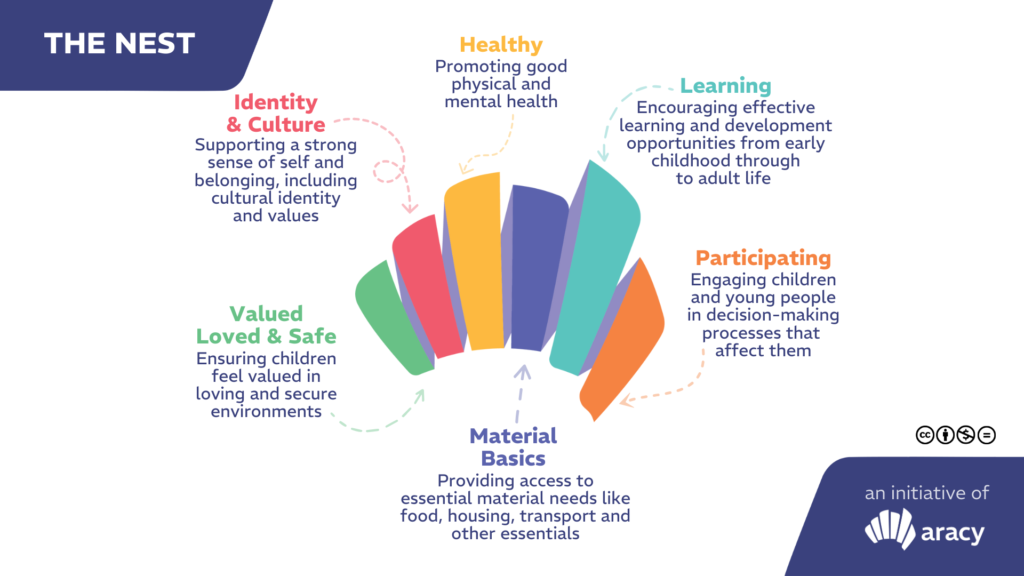
Click on the domain below to find out more



The Nest is licensed under Creative Commons so it’s free to use in your policies or practice.
Find out more below.
Frequently asked questions
Why is it called The Nest?
The name came from a young person at the national summit held to finalise the framework. They described all the areas of wellbeing as forming a nest — “if every area is supported, we’re able to be happy and healthy and fly from the nest.” The image resonated with everyone in the room, and the framework has been known as The Nest ever since.
Who is The Nest for?
The Nest applies to children and young people aged 0 to 24 years. It is used by individuals, services, government agencies, researchers, and community organisations — anyone working with or for children and young people can use The Nest to frame their thinking and practice.
What does 'wellbeing' mean in The Nest?
The Nest treats wellbeing as an umbrella term encompassing all six domains together. When many people talk about wellbeing, they often mean one or two aspects — such as mental health or social-emotional learning. While these are important, The Nest takes a holistic view: optimal wellbeing means a child or young person is adequately supported across all six domains, not just one or two.
How was The Nest developed?
Development began in 2010 at a meeting at Parliament House in Canberra. Over two years, ARACY consulted with more than 4,000 children, families and professionals across Australia, asking what it means to have a good life. Children and young people were central to this process, sharing their perspectives through drawing, group discussions and surveys. ARACY researchers also reviewed hundreds of Australian and international programs and strategies. The Nest was officially launched in 2012 and has been updated regularly to reflect new evidence and our changing world.
How is The Nest being used?
The Nest is used in many ways across Australia and internationally, including as a conceptual framework for developing strategies and plans; to monitor and evaluate children’s outcomes; to track student wellbeing in real time through tools like EI Pulse; to guide community engagement and conversations with children and families; and as a shared language for organisations, governments and researchers working across sectors. The Common Approach®, ARACY’s evidence-based practice framework, is built on The Nest’s foundations.
What principles guide the use of The Nest?
Six operational principles underpin The Nest:
- Placing the child at the centre
- Privileging Aboriginal and Torres Strait Islander knowledge
- Taking a long-term, evidence-informed approach
- Prioritising prevention and early intervention
- Applying a life stage lens with particular attention to the early years and key transitions
- Working toward systemic change through shared outcomes, reformed funding, and collaboration across sectors and governments
How do I use The Nest?
The Nest can be used at any level — from individual practice through to service planning, policy development, and population-level data analysis. In practice, this might mean using The Nest to frame conversations with children and families about wellbeing, to design or evaluate a program, to develop a strategy or community plan, or to align data collection across sectors. Because it is licensed under Creative Commons, it is free to use. Download What’s In The Nest? to get started, or explore The Common Approach® for a structured way of putting The Nest into practice with children, young people and families.
What is the difference between The Nest and the Wellbeing Wheel?
The Nest and the Wellbeing Wheel are related but distinct tools. The Nest is the overarching framework — it defines the six domains of wellbeing that children and young people need to thrive and is used at every level, from individual practice through to national policy.
The Wellbeing Wheel is a practical tool within The Common Approach®, ARACY’s evidence-based way of having quality wellbeing conversations with children, young people and families.
The Wheel uses The Nest’s six domains as its foundation, giving practitioners a visual, accessible way to explore wellbeing with the people they work with. In short: The Nest is the framework; the Wellbeing Wheel is one of the tools used to bring it to life in practice.
DOWNLOAD
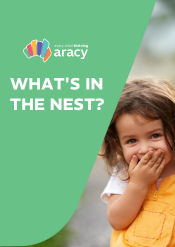
What's In The Nest?
Download What’s In The Nest? to learn more about this wellbeing framework and how you can use it.
PDF 1.5MB
DOWNLOAD
Download The Nest technical document
This technical document underpins the action agenda, offering a comprehensive overview of The Nest’s development, methodology, and evidence-based strategies since its inception in 2009-10.
PDF 1.5MB
DOWNLOAD
Download The Nest and the UNCRC
The Nest is a child-centred framework that defines what children and young people need to thrive across six interconnected wellbeing domains, aligning closely with the UNCRC, which outlines these needs along with the roles and responsibilities of governments, families, and organisations in upholding children’s rights.
PDF 1.5MB
WHAT WE DO
Looking for more?
Search through our extensive Resource Library including Research papers, Submissions, Reports and much more.
The Nest in action
The Nest is a widely adopted framework guiding policy and practice to promote wellbeing and prevent disease across Australia and beyond.
Our Nest Projects
At ARACY, we’ve pioneered Australia’s premier evidence-based wellbeing framework, The Nest. We base all our work on the six interlocking dimensions of The Nest. It ensures children’s and young people’s wellbeing – including health, is always at the centre of our work. See our Nest Projects.
The Nest Initiatives
The Nest is Australia’s leading framework for enhancing holistic wellbeing, including health, of children and young people. It unites efforts across the nation to boost the wellbeing and health of our next generation. See the Nest Initiatives.
What is child wellbeing?
Wellbeing is a commonly used term, but it can mean different things to different people. This variability in interpretation can make it challenging to fully understand what wellbeing entails and, ultimately, to improve the health and wellbeing of children and young people. Find out more.