What We Do
Systems Reform Tool
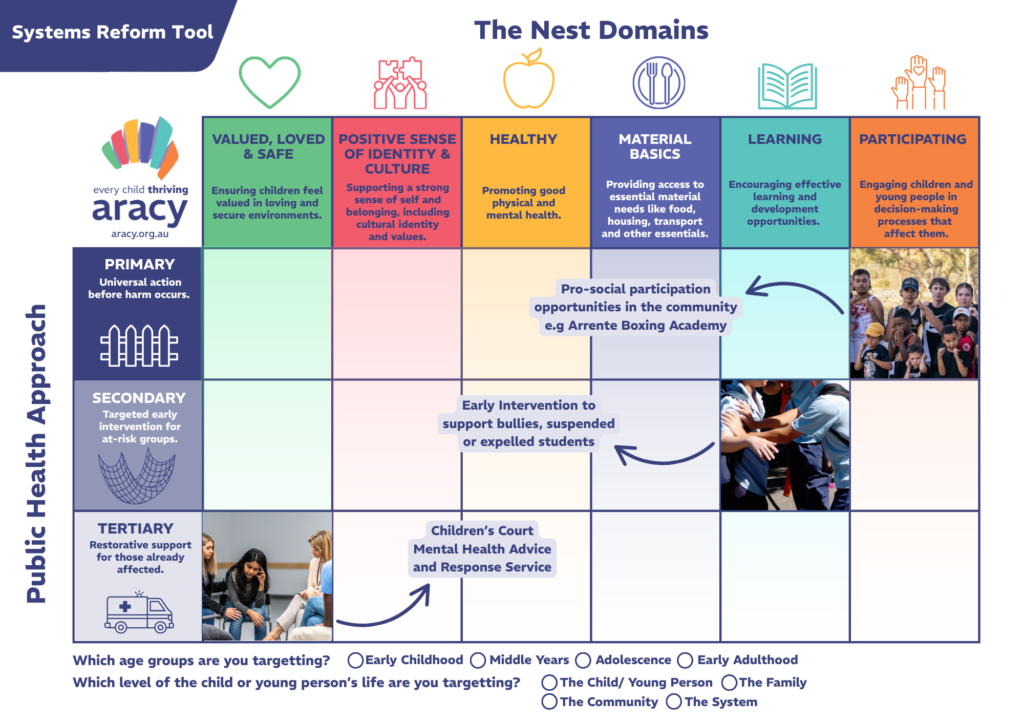
The Nest Wellbeing Framework maps what children and young people need to thrive across six domains and three levels of intervention — primary, secondary and tertiary.
This tool puts The Nest to work. It is designed for service planners, policy makers and practitioners who want to map their system, find the gaps, and identify where reform effort will have the greatest impact.
For the evidence base and policy context behind this tool, read Raising Children Up — Shutting Detention Down.
How to use it
Download the tool, print it out, and work through it with your team. It is designed to be written on.
Three ways in
- Map your service. Find where your work sits in the framework. Then look at what sits alongside it — and what is missing.
- Find the gaps. Most justice-related spending concentrates in the tertiary row. Use the tool to identify where primary and secondary investments are absent in your system.
- Apply an ecological lens. For each cell, ask which layer of the child’s world the intervention reaches — the child, the family, the community, or the system. The most effective interventions work across multiple layers.
Add an age cohort lens.
Children’s needs shift across the life course. The tool prompts you to map which age groups your system is serving — and which it is missing. Early childhood, middle years, adolescence and early adulthood each carry distinct developmental significance and service gaps.
A note on First Nations communities. This framework was developed in consultation with First Nations communities and organisations. When using it with or for First Nations children and families, apply it alongside — not instead of — community-led knowledge, cultural frameworks and self-determination principles.
Want to go deeper?
Read Raising Children Up — Shutting Detention Down — ARACY’s practical roadmap for shifting investment upstream and reducing youth offending by strengthening the conditions children need to thrive.
Visit our All In for Growing Deadly Brains page with recordings and resources from our growing Deadly Brains Reconciliation Week webinar.
More reading:
Dekol means knowing our history, so we are not bound to repeat it
Place 2.0: A Transformative Approach to Community Development
Find out how other people use The Nest
ARACY also works with organisations and systems to apply The Nest in practice.
WHAT WE DO
Looking for more?
Search through our extensive Resource Library including Research papers, Submissions, Reports and much more.
ARACY's The Nest

What's in The Nest?
With six connected areas, The Nest ensures young Australians have everything they need for the best start in life, helping them reach their highest potential.

Our Nest projects
Using The Nest, has helped ARACY to be at the forefront of disease prevention and the promotion of holistic health for young Australians.

The Nest initiatives
Here you’ll see some examples of how The Nest has been used in organisations outside of ARACY across Australia.